PTHive: Designing a Digital Platform to Support Youth Mentorship
A youth mentorship platform created with The Prince’s Trust to help vulnerable young people build confidence and stay connected with mentors through structured, safe, and empowering digital experiences.
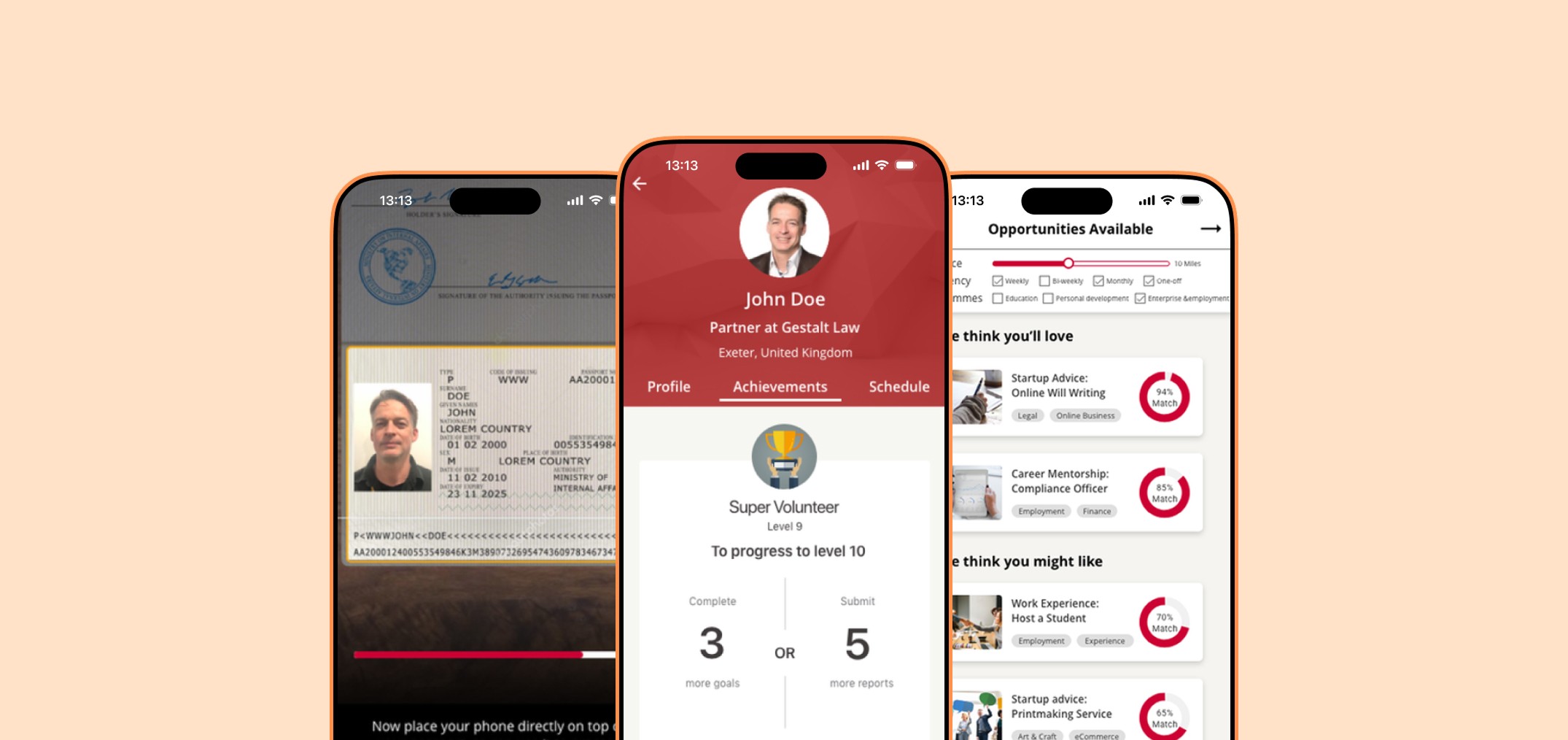
Lead Product Designer
A 7-person sprint team spanning Design, Product, Engineering, and Research, working in collaboration with The Prince’s Trust.
4 months, 2018 - 2019 (from discovery through to validated prototype).
Non-Profit · Social Impact
CONTEXT
Challenge
Youth mentorship at The Prince’s Trust relied heavily on offline conversations, paper notes, and scattered spreadsheets. Mentors struggled to track goals and session history, while mentees often felt overwhelmed and lacked a clear sense of progress. This fragmented process made it difficult to sustain momentum, particularly during staff turnover or long breaks between sessions.
The Task
Create a digital platform that gives mentors simple tools to prepare, capture notes, and follow through, while empowering young people to track progress and stay engaged.
Proposed Solution
Introduce a shared digital space for mentors and mentees, built around core features such as session timelines, lightweight reflections, and progress tracking.
If a full rollout was not immediately feasible, start with quick wins like a mentor dashboard and reflection tools to deliver immediate value, build trust, and lay the foundation for a scalable mentorship platform.
Here’s how we translated early ideas into a tangible digital platform for mentors and young people.
DISCOVER
Grounding the Problem in Research
Research strategy to understand mentoring needs and barriers
I shaped our research plan to uncover where mentors and young people struggled in the mentoring journey, what supported their confidence, and how they felt about using a digital tool to track goals and progress.
This plan included:
Reviewing program materials such as intake forms and reflection sheets
Running a workshop with mentors, staff, and a youth ambassador
Conducting contextual interviews to map challenges and opportunities
Here are key themes we explored and insights uncovered during our research:
By facilitating synthesis workshops, we identified clear opportunities to strengthen connection and continuity with a shared digital platform for mentors and mentees.

"I want to see the progress I’ve made, not just talk about it."

"“It would help if I could write down what I learned after each session.”"

"Having everything in one place would make it easier to stay on track."
DEFINE
Defining the Problem
We used a structured set of design artefacts to align the team and stakeholders around real user needs.
This included stakeholder mapping to set priorities, personas and empathy maps to capture needs and emotions, journey mapping to surface pain points, How Might We statements to frame opportunities, and a practical vs. impractical exercise to filter ideas into feasible directions. While some of these artefacts are often part of Discover, we present them here in Define because they directly shaped our problem framing and guided design decisions.
Stakeholder Mapping
We mapped priorities across The Prince’s Trust, SAP sponsors, mentors, and youth ambassadors. This clarified where needs overlapped and where trade-offs had to be made between organisational requirements and user needs.
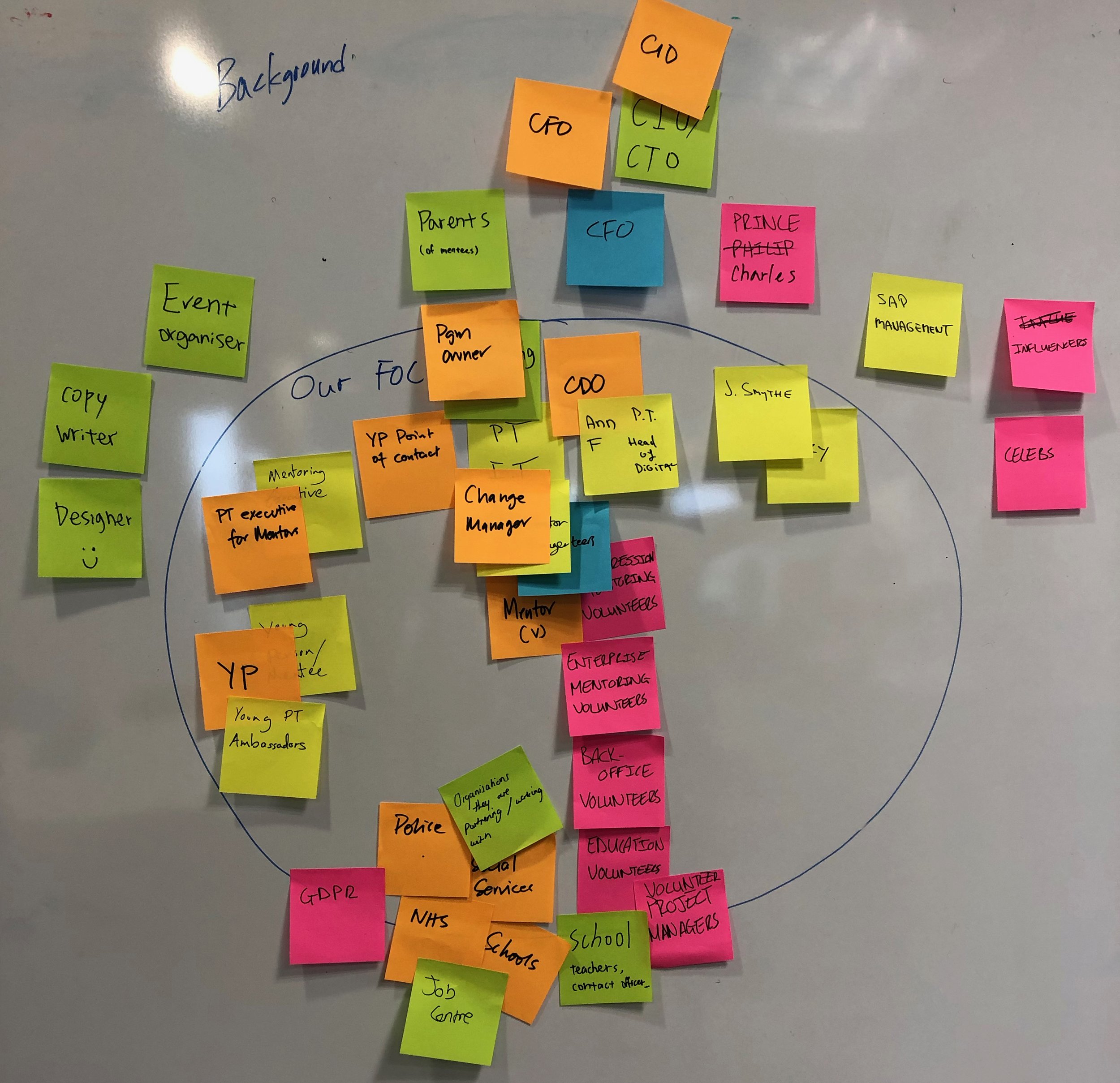
Stakeholder mapping workshop highlighting priorities, overlaps, and trade-offs across mentors, youth, and sponsors.
Personas
We developed two personas to anchor design decisions:
The Mentor: motivated to give back but juggling multiple commitments, needs lightweight tools to stay organised.
The Mentee: seeking guidance and confidence, often unsure about expectations, needs a safe space to reflect and track progress.
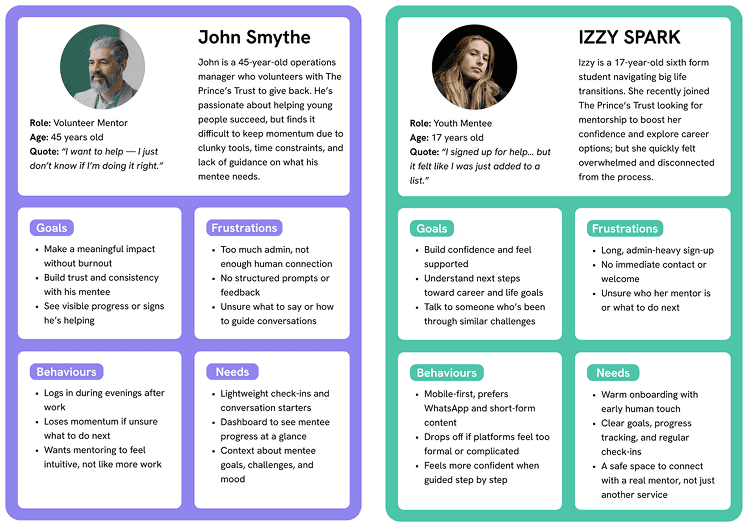
Personas capturing mentor and mentee needs, motivations, and pain points to guide design decisions.
Empathy Map
We built empathy maps for both mentors and mentees to capture what they say, think, feel, and do. These maps highlighted emotional barriers such as anxiety at the start, frustration with lost context, and the need for encouragement through visible progress.
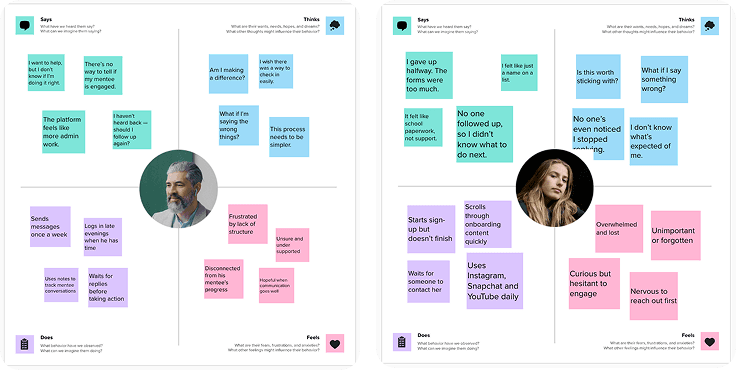
Empathy mapping exercise capturing what mentors and mentees say, think, feel, and do to surface emotional barriers and opportunities for support.
Journey Mapping
We mapped the mentee journey across touchpoints, surfacing pain points where progress was lost and identifying moments where digital support could reinforce structure and continuity.
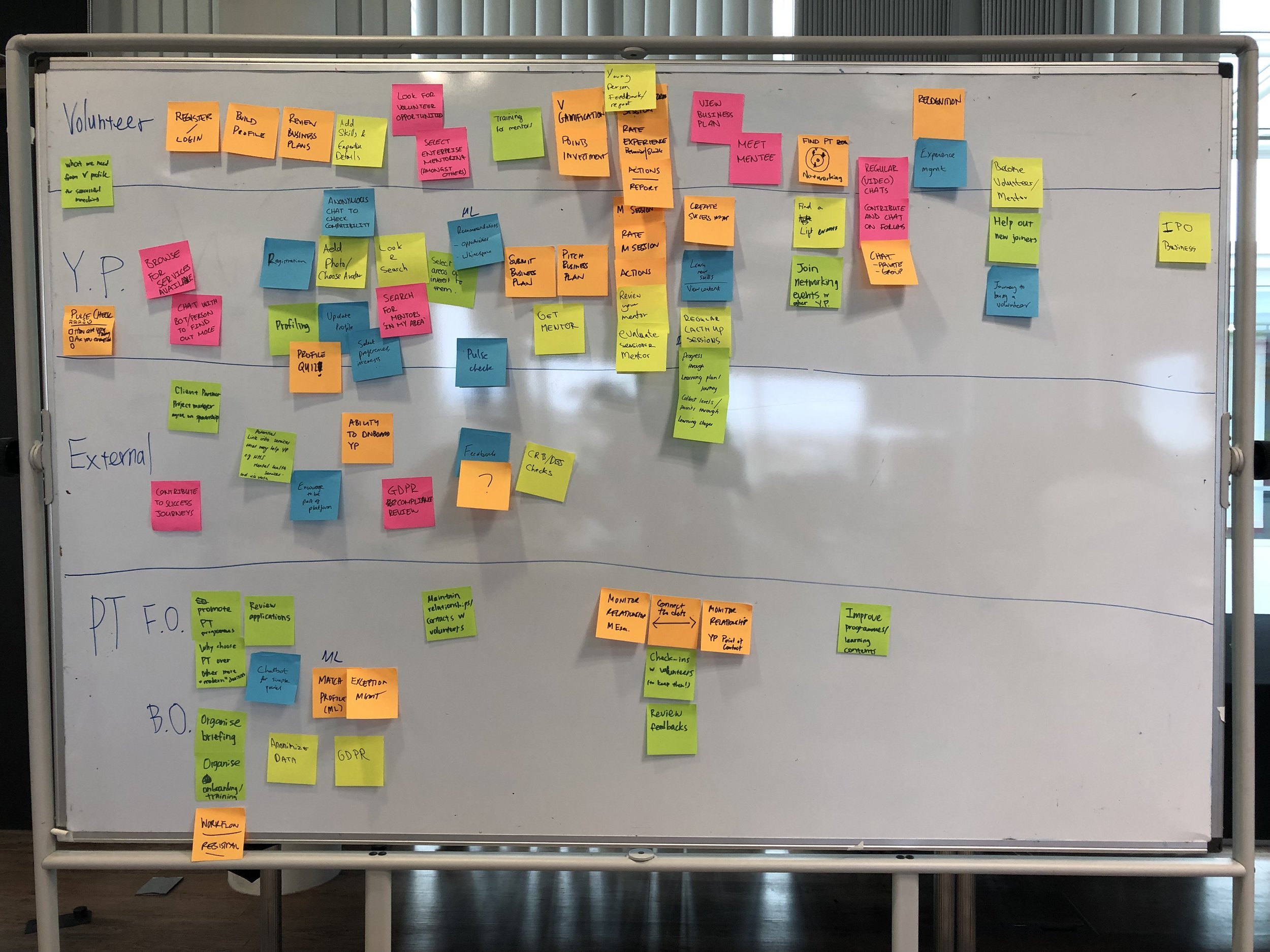
Journey mapping exercise visualising the mentee experience, highlighting pain points and opportunities for digital support to improve continuity.
How Might We Statements
To turn our research insights into actionable opportunities, we created a set of How Might We (HMW) statements. These framed the design challenge in a way that encouraged ideation while keeping the focus on mentors and mentees. After several rounds of refinement, we aligned on three core HMWs to guide our design exploration:
"How might we help young people feel safe, confident, and engaged throughout their mentoring journey?"
"How might we give mentors simple tools to prepare, track, and follow through without adding extra admin work?"
"How might we ensure continuity and visible progress across sessions, even during breaks or staff changes?"
Practical vs. Impractical
We used a practical vs. impractical exercise to quickly filter ideas. This allowed us to capture ambitious concepts while prioritising features that could realistically be built within the four-month pilot timeline.
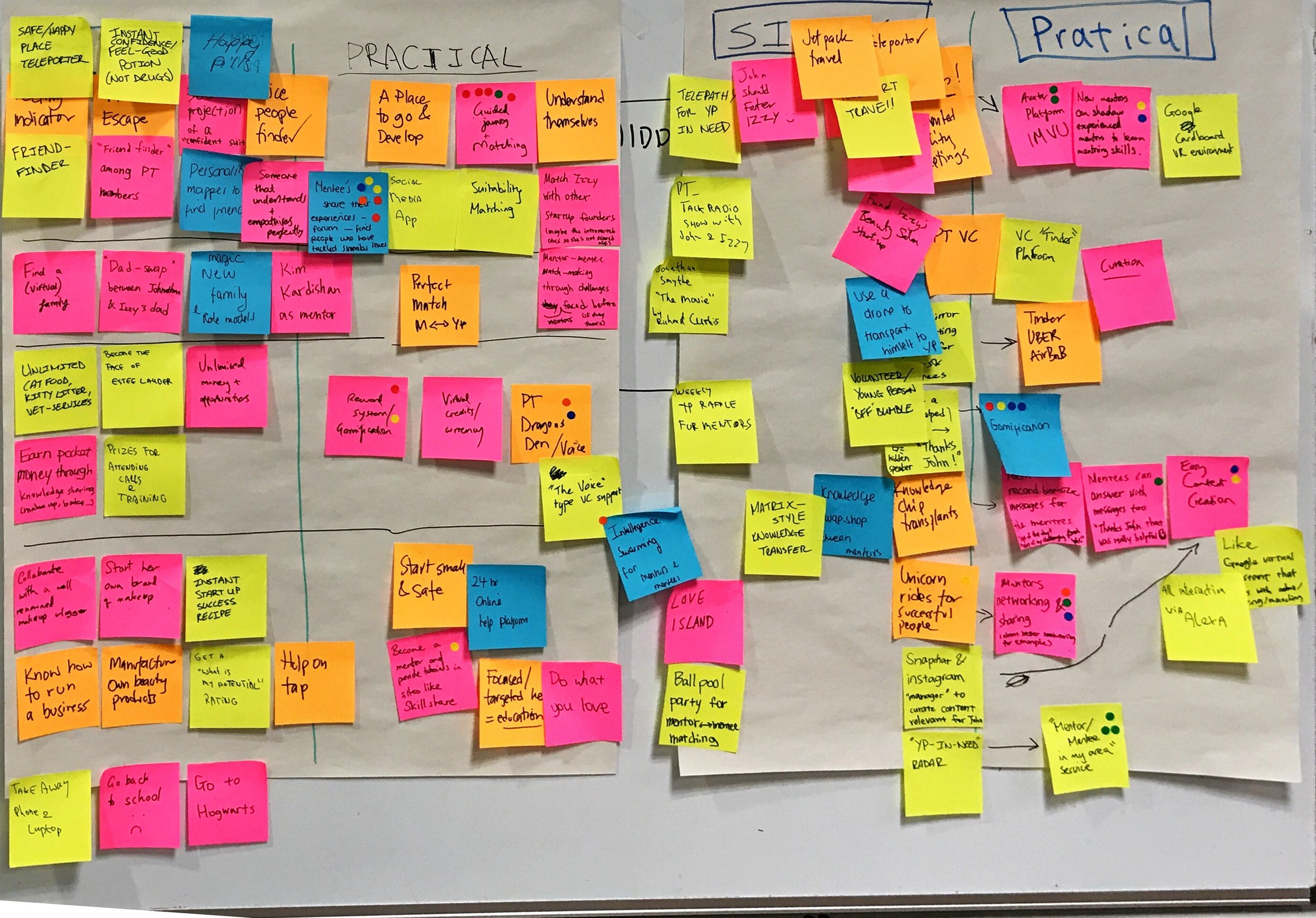
Practical vs. impractical exercise used to filter ideas, helping the team prioritise realistic features for the four-month pilot.
DEVELOP
Exploring Concepts to Support Mentors and Mentees
Building on our research insights and How Might We statements, we explored a digital platform to reduce friction in mentoring, focusing on tools that felt simple, safe, and empowering.
I facilitated Crazy 8s workshops to spark ideas, led prioritisation with dot voting and practical vs. impractical filtering, and mapped early user flows of mentor - mentee journeys. These steps showed where digital support could add value without extra burden.
Crazy 8s & Dot Voting
We used Crazy 8s sketching to generate a wide range of ideas quickly, encouraging the team to push beyond the obvious. Through dot voting, we narrowed the concepts to those that offered the greatest impact while remaining feasible within the four-month timeline.
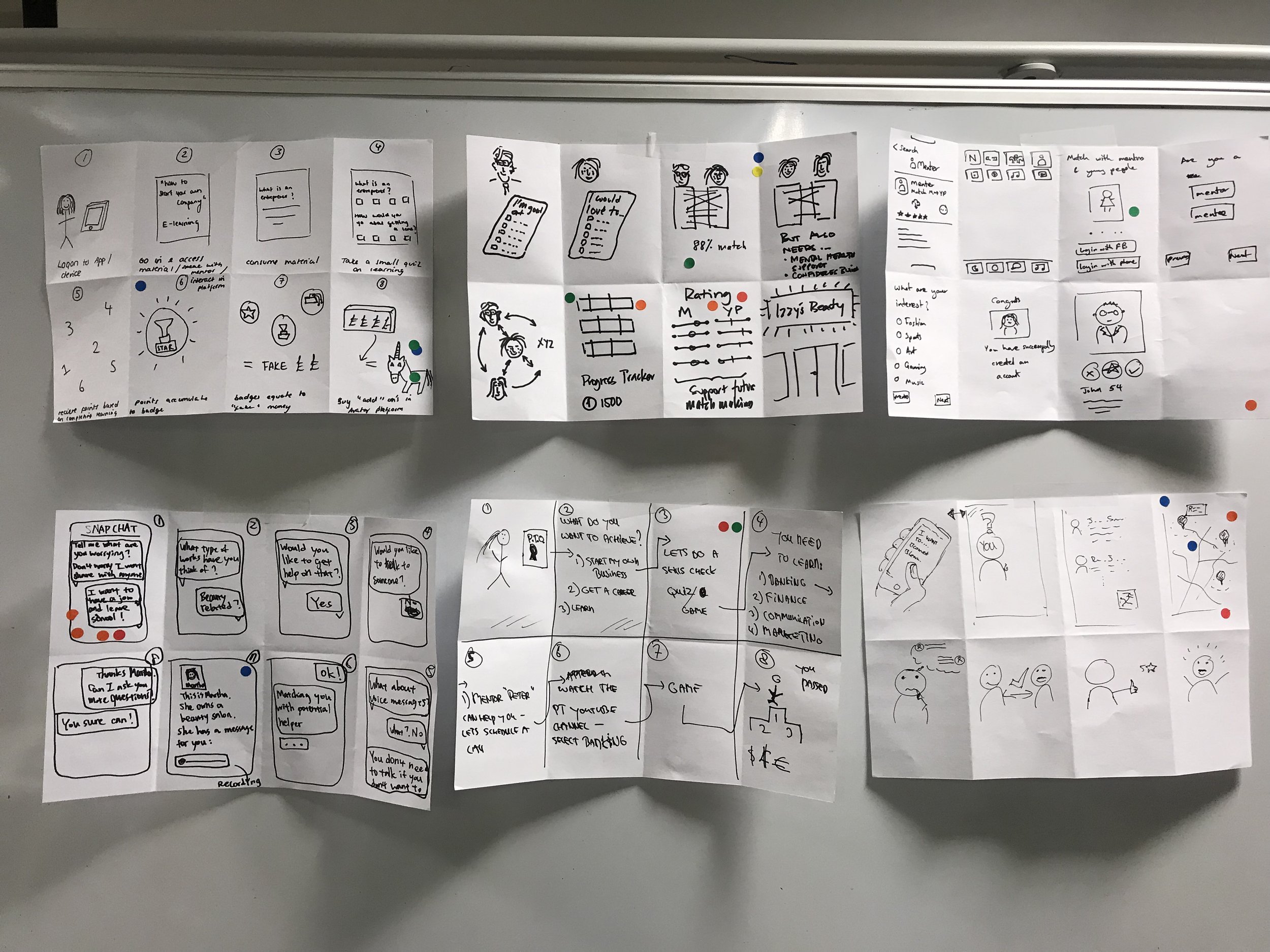
Crazy 8s sketches and dot voting outcomes, capturing rapid ideas and prioritised concepts for prototyping.
User Flows
To understand how ideas would play out in real mentoring journeys, we created early user flows mapping how mentors and mentees might prepare, meet, and reflect. These flows helped us visualise where digital tools could support continuity, reduce mentor admin, and provide visible progress without disrupting the natural rhythm of mentoring.
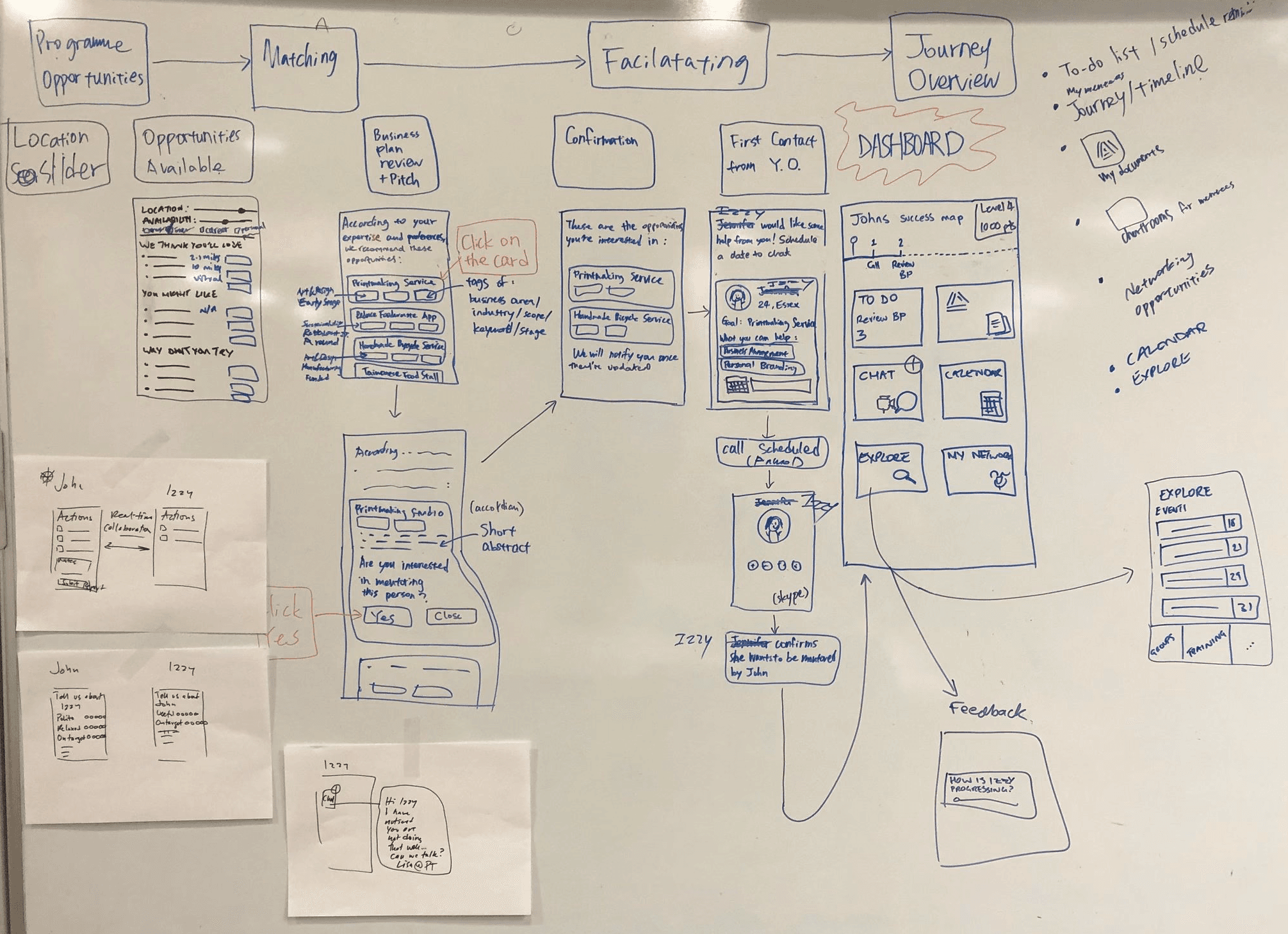
User flow workshop mapping how mentors and mentees prepare, meet, and reflect, highlighting opportunities for digital support.
Lo-Fi Wireframes
We translated key ideas into low-fidelity sketches, focusing on accessibility, clarity, and encouragement. These early concepts explored features such as a Session Timeline, Quick Reflections, a Progress Tracker, and a Mentor Dashboard.
Sharing these wireframes with mentors and staff allowed us to test clarity before moving into hi-fi prototyping. Feedback confirmed the importance of keeping reflections lightweight, dashboards simple, and progress tracking motivating rather than overwhelming.
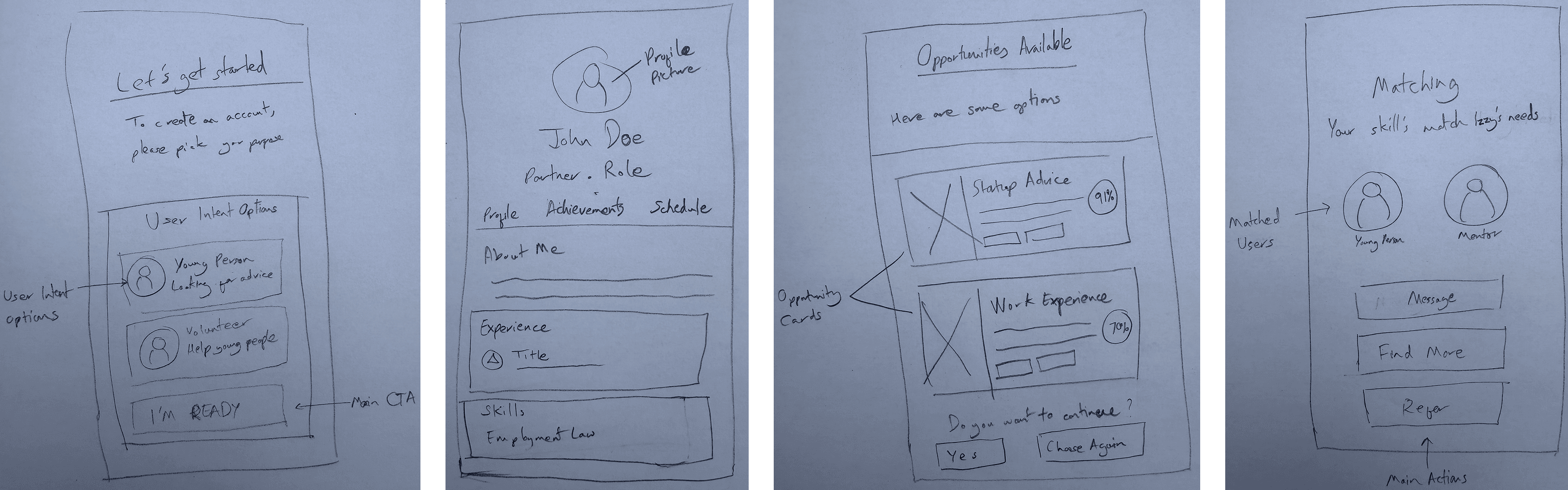
Early low-fidelity wireframes exploring session timelines, reflections, and dashboards to simplify mentoring workflows.
Prioritised Features
From this process we identified the most promising features to refine and prototype:
Session Timeline to give both mentor and mentee a shared record of notes and goals
Quick Reflections prompting short check-ins after each session
Progress Tracker helping mentees see their growth over time
Mentor Dashboard offering an overview of multiple mentees and upcoming sessions
Accessible UI designed with clear language and mobile-first interactions
DELIVER
Delivering Strategy, Not Just Screens
Final Recommendation to Stakeholders
At the close of the project, I delivered a validated Marvel prototype and a design strategy to The Prince’s Trust stakeholders. Based on research and testing, I recommended a unified digital platform rather than a companion tool. This approach simplified the mentoring journey, reduced friction, and gave both mentors and mentees a shared space to track progress and stay engaged.
High-Fidelity Prototypes
After implementing feedback from our low-fidelity sketches, I designed a comprehensive Marvel prototype that brought together all prioritised features. The designs focused on clarity, accessibility, and encouragement, ensuring they worked in the real-world context of youth mentoring.
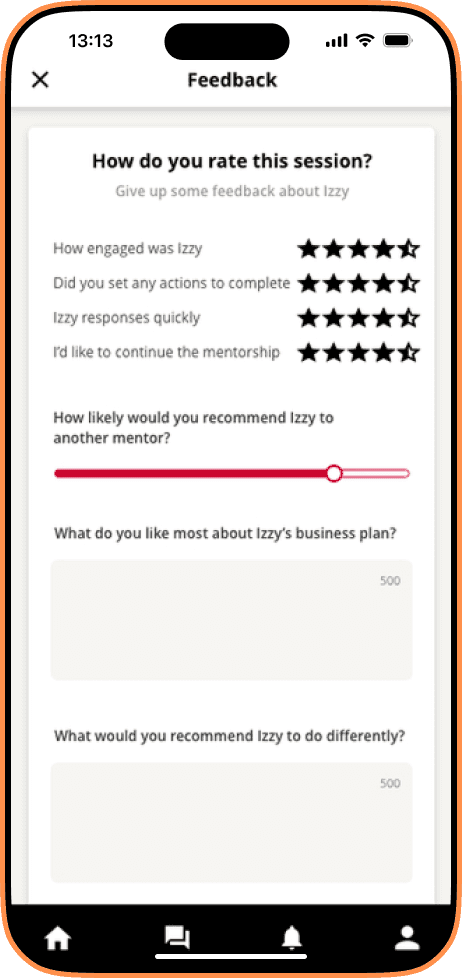
Feature 1: Session Reflection
Feature Explanation
Introduced a shared session timeline and quick reflection prompts. This version focused on continuity and giving mentees a voice after each session.
The "Why" Behind the Feature
The timeline helped mentors and mentees keep track of what was discussed, while reflections encouraged young people to articulate what they learned. Both were designed to be lightweight, ensuring they didn’t add extra admin work.
"It helps me remember what we talked about and what I need to do next."
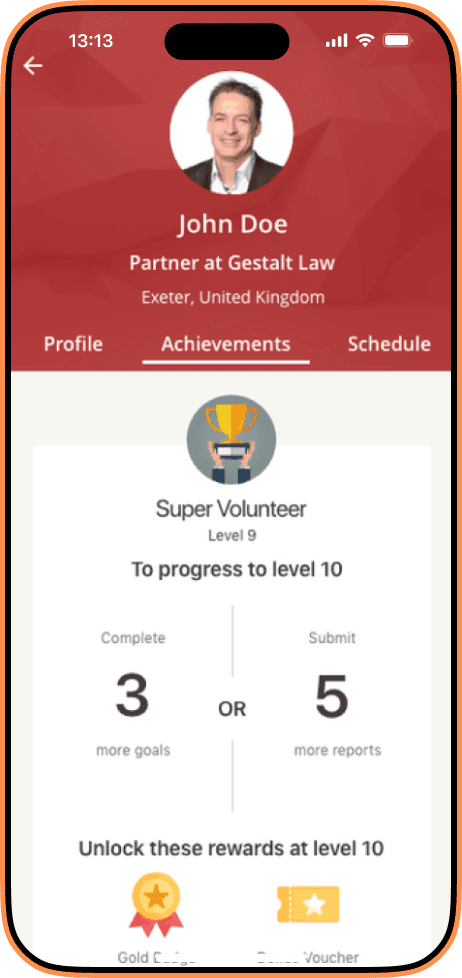
Feature 2: Mentor/Mentee Profile
Feature Explanation
Added a progress tracker to visualise achievements across themes such as confidence, wellbeing, and readiness.
The "Why" Behind the Feature
Mentees wanted to see tangible signs of progress. The tracker gave them a way to celebrate small wins and stay motivated, while mentors valued having a tool to show growth over time.
"I like seeing how far I’ve come. It makes me want to keep going."
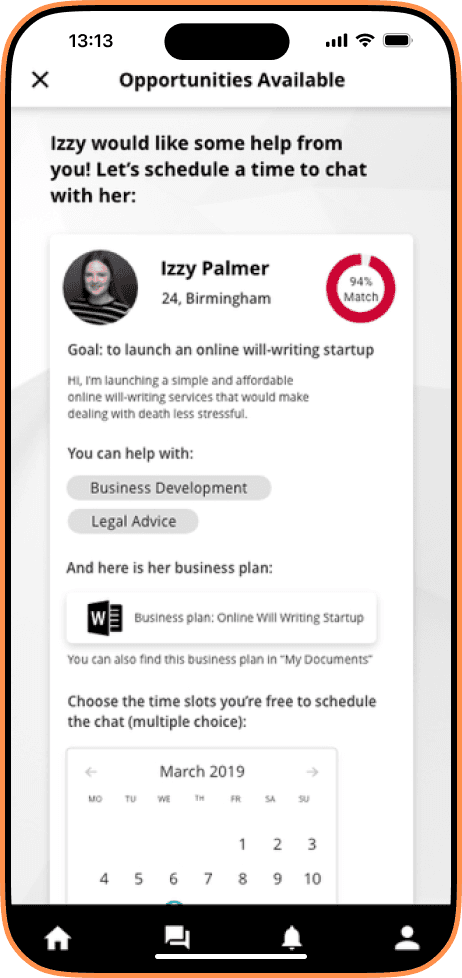
Feature 3: Mentor Dashboard
Feature Explanation
Introduced a mentor dashboard for those supporting multiple mentees. This provided an overview of upcoming sessions, unresolved actions, and mentee reflections.
The "Why" Behind the Feature
Mentors needed a simple way to manage relationships without losing track of details. The dashboard reduced cognitive load and gave them confidence that nothing was being missed.
"This gives me a clear picture of where everyone is at, and what I need to prepare."
Usability Testing Approach
To validate our high-fidelity prototypes, we ran both qualitative and quantitative testing:
Qualitative
6 mentors and 4 mentees participated in moderated sessions, providing feedback on usability, clarity, and engagement.
Quantitative
A follow-up survey with 25 respondents measured ease of use, confidence, and likelihood of adoption.
The Results Were Clear: Embedded AI, Not Separate Tools
Quantitative Results
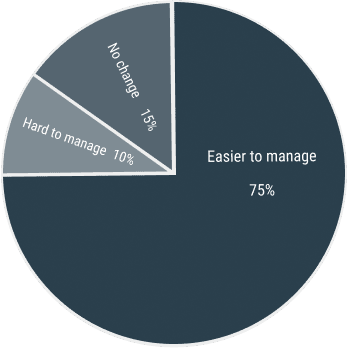
75% of mentors said the integrated platform made it easier to manage and support multiple mentees effectively.
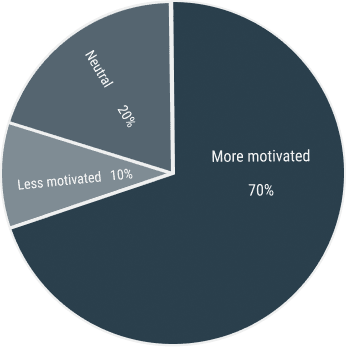
70% of mentees reported feeling more motivated when they could see progress and reflections in one space.
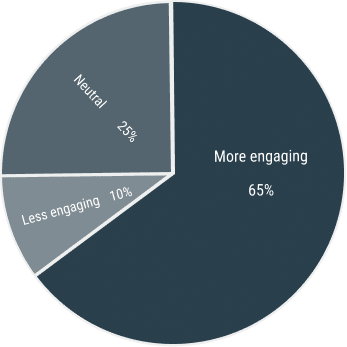
65% of participants agreed the unified approach was more engaging than juggling separate tools.
Qualitative Validation
"It helps me keep track without juggling spreadsheets and paper notes."
"Seeing my progress in the same place as my reflections makes me want to keep going."
"Having everything together feels less overwhelming than using different apps."
The final presentation was well received by The Prince’s Trust. Stakeholders saw the platform not just as a prototype, but as a strategic step toward modernising mentoring with digital support. The recommendation was approved for a pilot rollout to test its impact with mentors and young people in a real programme setting.
IMPACT
Impact of the Strategic Question I Asked
During the project, we reframed a critical assumption: instead of building a separate companion tool, should mentors and mentees have one shared platform?
Reframing the problem around one shared platform led to:

A pivot from fragmented tools to one integrated space supporting mentors and mentees together.

User buy-in for continuity and progress, with both mentors and mentees valuing motivation and clarity.

Stakeholder confidence in a scalable direction, backed by evidence from testing and prototypes.
Long-term Impact for The Prince's Trust
The project left value beyond the prototype itself:
Created a validated design prototype that could be expanded into a live pilot
Introduced user-centred design methods (personas, journey maps, empathy mapping) that influenced future digital initiatives
Sparked conversations across the organisation about how digital tools can strengthen mentoring relationships and provide continuity for young people
What This Meant for Mentorship
For mentors, the platform offered a way to stay organised and manage multiple mentees with less admin load. For young people, it provided clarity, progress tracking, and encouragement that built confidence over time. Together, it demonstrated how digital design can enhance human relationships when approached with empathy and evidence.
REFLECTION
Adapting Quickly, Creating Lasting Value
This project challenged me to design within tight constraints, bring together diverse voices, and deliver a solution that was both practical and inspiring for young people and their mentors.
🌍 Designing with Empathy
Mentorship is as much about emotions as it is about structure. Research revealed that mentees needed encouragement and mentors needed tools that reduced effort, not added more. The biggest shift came from reframing the problem around continuity and confidence, rather than simply digitising paperwork.
What I Did
Facilitated discovery workshops that uncovered hidden emotional needs
Translated insights into features that balanced structure with flexibility
Advocated for simplicity and safety as guiding design principles
⚡ Turning Constraints into Clarity
With only four months to move from research to a validated prototype, the team needed to focus on features that delivered immediate value. By narrowing scope and prioritising, we proved that even small, well-designed features could create momentum and trust.
What I Did
Prioritised session timelines, reflections, and progress tracking as MVP features
Created lightweight flows before scaling into a cohesive prototype
Balanced ambition with what was realistic for a pilot program
🤝 Building Shared Ownership
Working with The Prince’s Trust meant balancing the perspectives of mentors, youth ambassadors, and sponsors. Each group had different expectations, but aligning them required evidence-backed design and a focus on the shared mission: empowering young people.
What I Did
Brought diverse voices together in co-creation workshops
Anchored recommendations in research insights, not assumptions
Delivered prototypes that resonated with both mentors and stakeholders
💡 My Key Learnings
Design for Continuity
The breakthrough came from realising that fragmented tools created more barriers. A single integrated platform was essential to maintain momentum and build trust.
Balance Structure with Flexibility
Mentorship thrives on both guidance and trust. Designing the right mix of structure and open reflection was essential for adoption.
Keep Users at the Center
This experience reinforced my belief that thoughtful design can empower vulnerable young people, strengthen human relationships, and create long-term value for organisations that support them.
This project showed me the power of designing with empathy under real-world constraints. By focusing on continuity, clarity, and trust, we moved beyond creating a prototype to shaping a vision for how digital tools can strengthen mentorship and unlock long-term impact for young people.