SAP ICSM: Intelligent Clinical Supply Management
A collaborative platform built with SAP, Tenthpin, and global pharmaceutical companies to modernize clinical trial supply chains. ICSM improves forecasting accuracy, streamlines complex workflows, and provides trial managers with greater visibility, flexibility, and control across global operations.
Lead Product Designer
Solution Architects, Developers, Life Sciences SMEs, Design Thinking Coach, and customer stakeholders from SAP, Tenthpin, and pharmaceutical companies
2019 – 2021
Enterprise software for the life sciences and pharmaceutical industry
CONTEXT
Challenge
Clinical trial supply chains are highly complex, with managers struggling to track inventory, forecast demand, and coordinate across regions. Many still relied on outdated spreadsheets and manual processes, which led to errors, slowed planning cycles, and made it difficult to respond to real-world changes. These inefficiencies carried significant financial risk, as mistakes in supply planning could cost hundreds of thousands of dollars per dose.
The Task
Create a modern platform that gave trial managers visibility, flexible forecasting, and streamlined workflows to simplify planning, accelerate decisions, and improve collaboration.
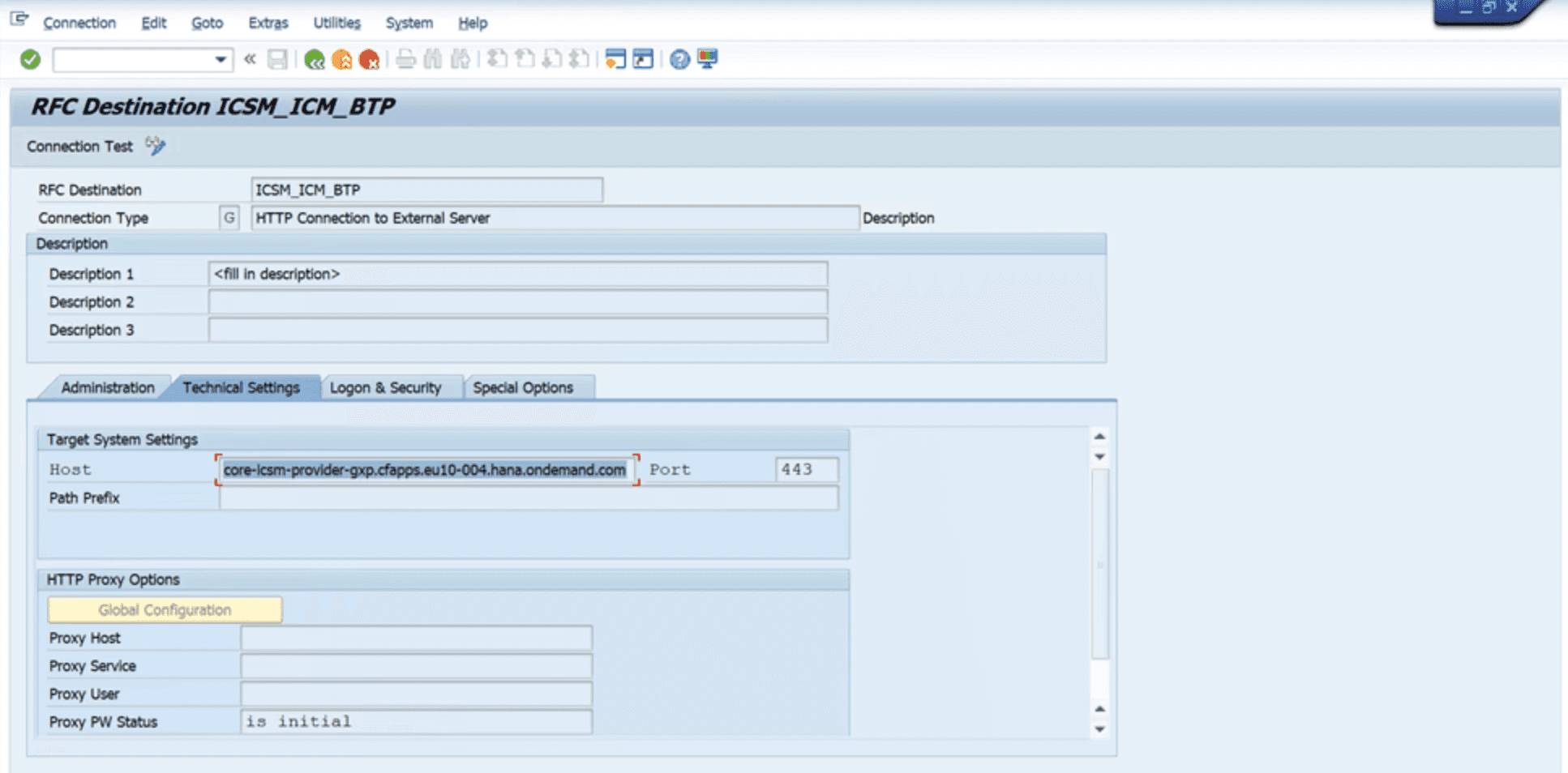
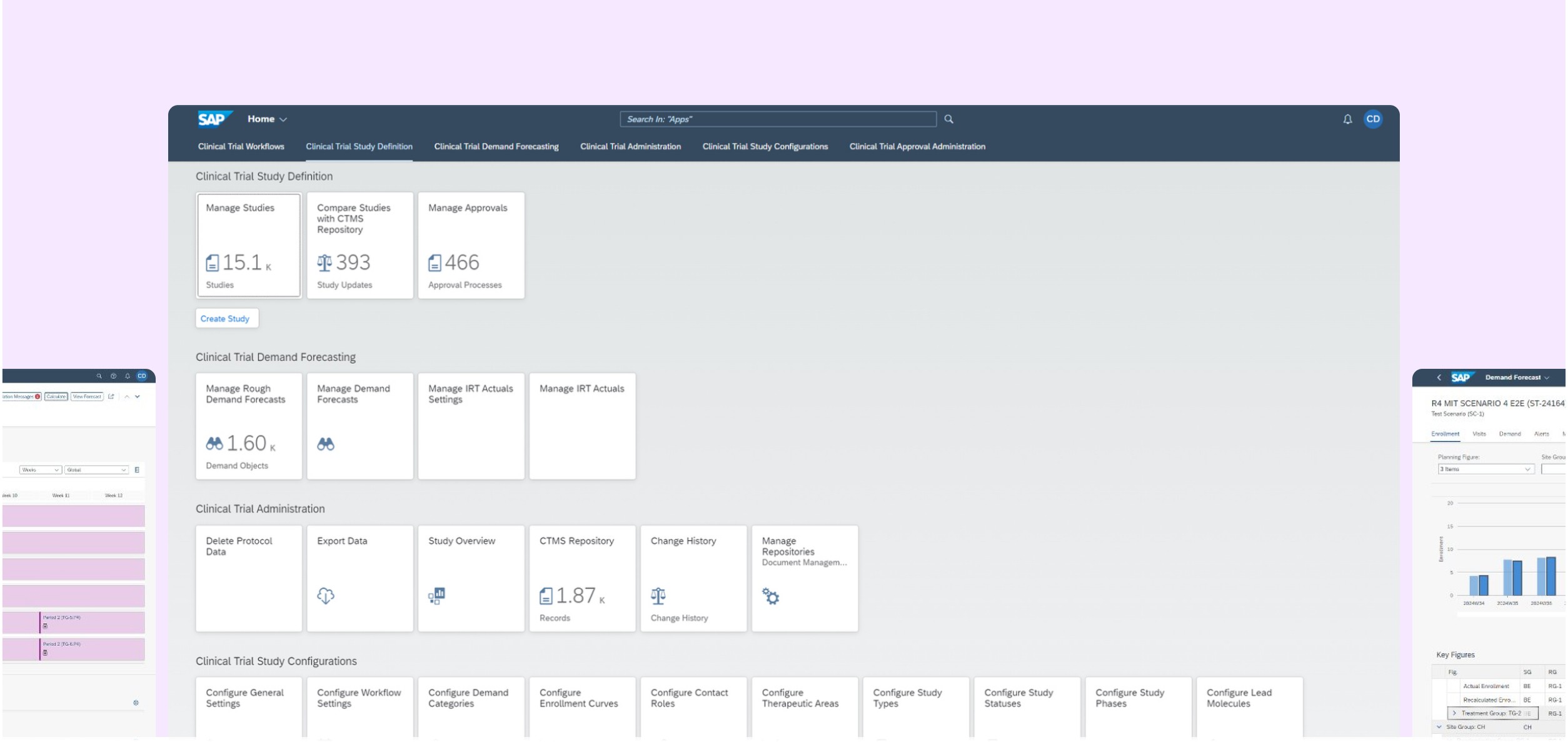
Pre-ICSM Setup: Clinical trial managers relied on SAP S/4HANA on-premise, facing manual, complex workflows before moving to SAP ICSM’s automated supply system.
Our Approach
We focused on introducing features that addressed the most urgent challenges:
Scenario Comparison Tool to evaluate multiple planning options side by side
Manual Demand Forecasting Module to adjust plans quickly based on live trial data
Integrated communication and task management to reduce reliance on emails and spreadsheets
If full rollout wasn’t feasible, we proposed starting with scenario comparison and manual forecasting as quick wins to deliver value, validate adoption, and lay the foundation for broader optimisation.
This case study shows how these recommendations were shaped, validated, and delivered in collaboration with global pharmaceutical partners.
DISCOVER
Researching the Trial Experience
I helped shape our team’s research strategy to uncover how trial managers, supply chain coordinators, and life sciences experts navigated complex clinical operations.
The goal was to identify bottlenecks in forecasting, understand the pressures behind decision-making, and generate insights to guide a more transparent and reliable system.
Our research approach included:
Reviewing existing workflows and documentation across multiple pharmaceutical partners
Developing interview scripts to ensure consistency across regions and roles
Running remote workshops with stakeholders in six countries during the pandemic
Conducting user interviews and prototype reviews with trial managers, operations staff, and regulatory experts
Key challenges and opportunities that surfaced during our research included:
Through workshops with pharma partners, we identified opportunities to improve forecasting, streamline collaboration, and increase visibility for trial managers.

"Tracking changes in spreadsheets always causes errors."

"I feel like I’m making critical decisions without enough reliable data."

"Having a single source of truth would save us time and reduce errors."
DEFINE
Framing the Challenge
We framed the problem through a structured set of design artefacts to align the team and stakeholders around real user needs.
This included stakeholder mapping to align priorities, personas and empathy maps to capture needs and emotions, journey mapping to surface pain points, How Might We statements to frame opportunities, and a practical vs. impractical exercise to filter ideas into feasible directions. While some of these artefacts are often part of Discover, we present them here in Define because they directly shaped our problem framing and guided design decisions.
Stakeholder Mapping
We mapped priorities across trial managers, supply planners, SAP sponsors, and pharma partners. This clarified where needs overlapped and where trade-offs had to be made between regulatory requirements, operational efficiency, and user experience.

Stakeholder ecosystem mapped by influence and proximity, placing core clinical supply users at the centre and regulatory, technology, and logistics partners in outer rings to balance user needs, compliance, and operational complexity.
Personas
We developed two personas to anchor design decisions:
Trial Manager: accountable for ensuring the right drugs reach the right sites at the right time. Needs forecasting tools and scenario comparisons to reduce risk.
Supply Planner: focused on logistics and inventory. Needs real-time visibility and the ability to adapt quickly to enrolment changes or regional demands.
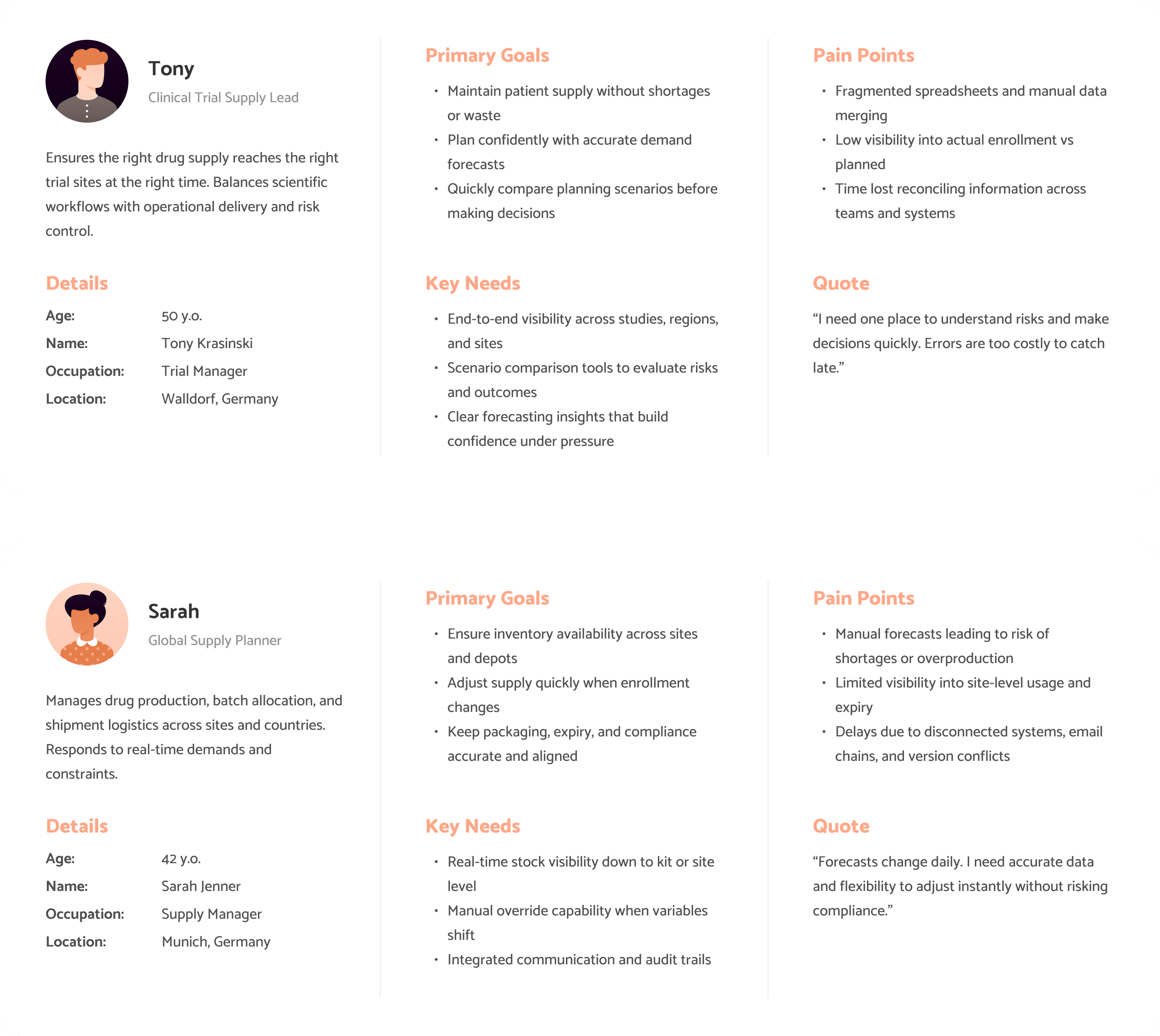
Trial supply personas aligned to real-world planning and compliance needs.
Workflow Mapping
Instead of empathy maps, we built workflow maps that traced how forecasting, enrolment data, and supply orders moved through teams and systems. These maps revealed friction points such as manual spreadsheet updates, handoffs between regions, and version misalignment, which slowed planning and increased risk.
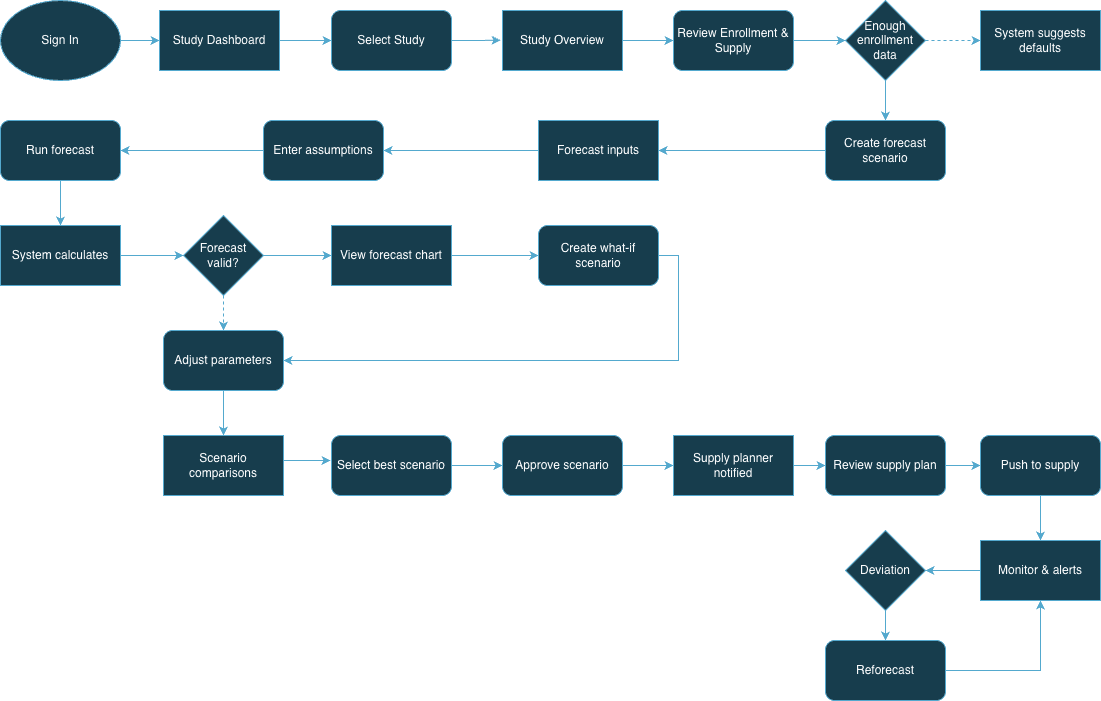
Workflow mapping visual below illustrates the flow from enrolment review to scenario planning, forecast validation, supply plan approval, and real-time monitoring.
Journey Mapping
We mapped the end-to-end trial planning journey for our primary persona, the Trial Manager. Although two roles contribute to clinical supply planning, the Trial Manager drives key decisions and initiates forecasting activities, so understanding their workflow first helped us surface the most critical friction points and opportunities.
Across key touch-points, we identified where visibility broke down, manual effort slowed decisions, and handoffs created uncertainty. This revealed moments where digital support could strengthen collaboration, build confidence in forecasts, and reduce risk across global study teams.
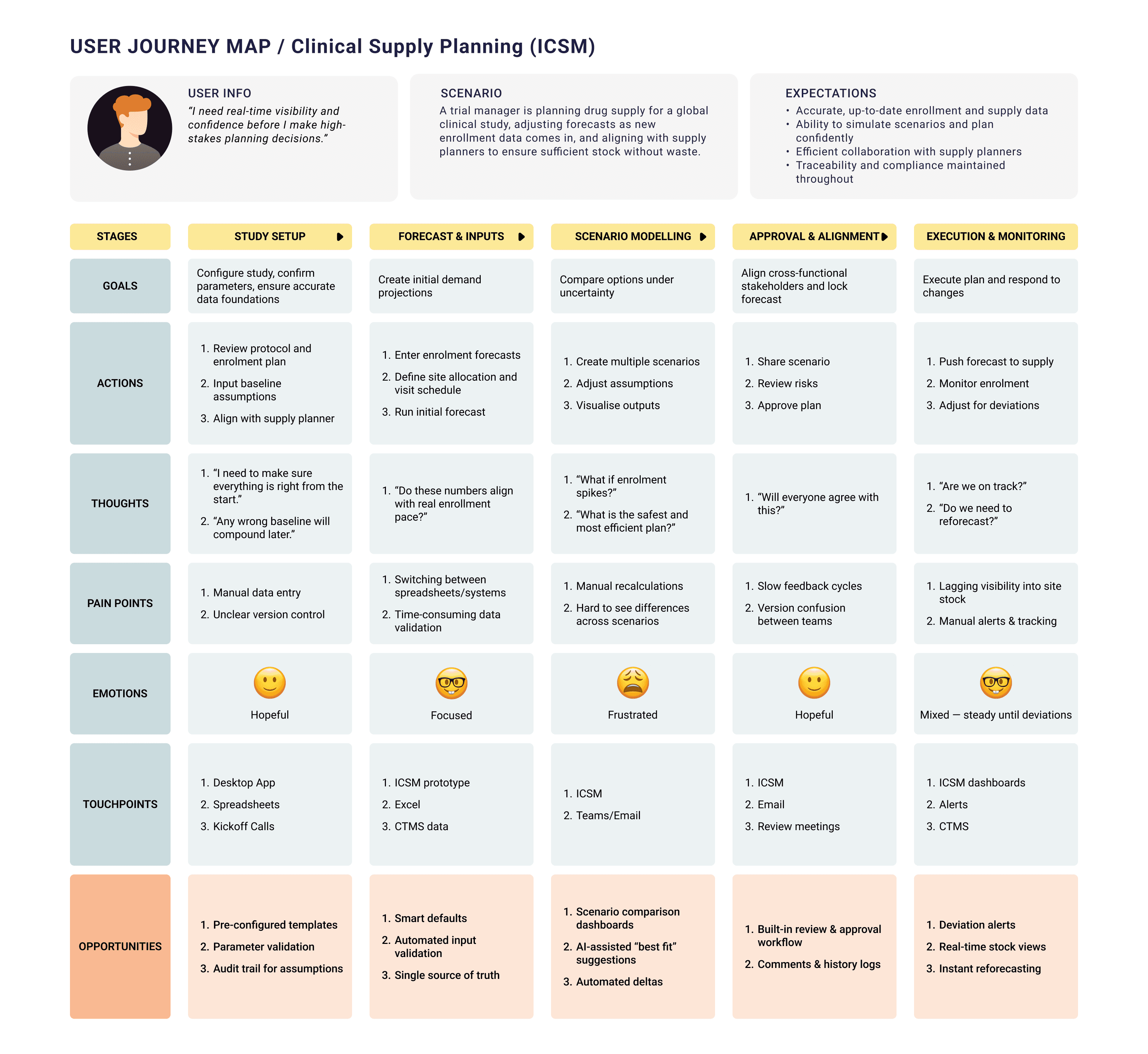
Journey map showing how trial managers plan, forecast, align with stakeholders, and respond to deviations, revealing pain points in visibility, manual effort, and collaboration.
How Might We Statements
To translate insights into opportunities, we created a set of How Might We (HMW) statements. These framed the design challenge in a way that encouraged ideation while keeping the focus on trial managers and planners. After several rounds of refinement, we aligned on three core HMWs to guide design exploration:
"How might we give trial managers better visibility and control of supply planning?"
"How might we reduce errors and delays from spreadsheet-based processes?"
"How might we enable faster, more confident decisions in high-stakes scenarios?"
Feasibility Mapping
We used a feasibility mapping exercise to quickly filter ideas. This allowed the team to capture ambitious concepts while prioritising features that could realistically be delivered within regulatory, technical, and operational constraints.
DEVELOP
Turning Insights into Ideas
We explored concepts for a unified platform to simplify clinical supply planning, focusing on tools that were intuitive, reliable, and easy to adopt.
I facilitated remote ideation workshops with stakeholders across six countries to spark ideas, introduced prioritisation exercises to balance user value with regulatory and technical feasibility, and mapped early user flows across forecasting and planning journeys. These steps showed where digital support could add value without creating extra overhead for already pressured teams.
Feature Prioritisation Workshop
We facilitated a prioritisation exercise with pharma partners, SAP, and Tenthpin stakeholders to weigh concepts against user value, regulatory feasibility, and technical effort. Using impact vs feasibility mapping, we narrowed ideas to those that offered the highest value with the least implementation risk, ensuring early wins while laying the foundation for long-term adoption.
Workflow Prototypes
To understand how concepts would fit real-world operations, we created workflow prototypes mapping how trial managers and supply planners plan, forecast, adjust, and communicate across regions. These flows highlighted opportunities for real-time visibility, reduced manual updates, and streamlined collaboration, making it easier for global teams to stay aligned.
Lo-Fi Wireframes
We translated key ideas into low-fidelity sketches, focusing on clarity, simplicity, and compliance. Early wireframes explored features such as a Scenario Comparison view, Manual Forecasting inputs, and Collaboration panels.
Sharing these with trial managers and pharma partners allowed us to test clarity before moving into high-fidelity prototyping. Feedback confirmed the importance of reducing clicks, avoiding unnecessary complexity, and ensuring features felt like a natural extension of existing workflows.
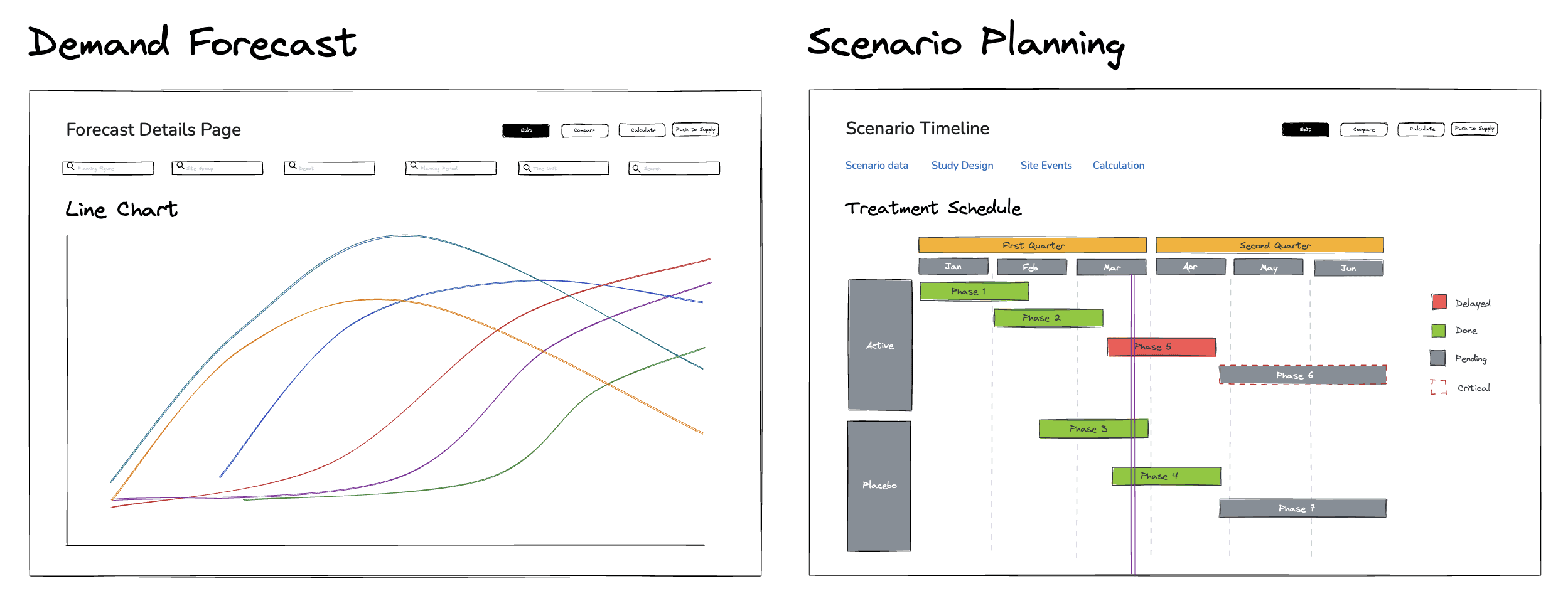
Early low-fidelity wireframes exploring demand forecast details page and scenario planning timeline page to simplify clinical supply chain management workflows.
Features We Took Forward
We selected the following features to advance into prototyping:
Scenario Comparison Tool to allow trial managers to evaluate multiple supply plans side by side and highlight key differences
Manual Demand Forecasting Module enabling quick adjustments in response to enrolment shifts or supply delays
Planned vs Actual Enrolment Analysis to surface early deviations and help teams act before issues escalate
What-If Scenario Planning to simulate outcomes under different parameters and prepare for uncertainty
Collaboration Panels integrating task management and communication into one central workflow
DELIVER
Delivering a Unified Strategy
Final Stakeholder Recommendation
At the close of the project, I delivered a validated Figma prototype and a design strategy to SAP and pharmaceutical stakeholders. Based on research and testing, I recommended moving forward with a unified ICSM platform rather than adding standalone forecasting tools. This approach simplified trial supply planning, reduced errors, and gave trial managers and planners a single source of truth for collaboration and decision-making.
High-Fidelity Prototypes
After refining our low-fidelity sketches with partner feedback, I designed a comprehensive Figma prototype that brought together all prioritised features. The designs focused on clarity, transparency, and ease of adoption, ensuring they fit seamlessly within the high-stakes environment of global clinical supply management.
Feature 1: Study Setup & Parameters
Feature Explanation
Introduced tools to define and manage complex study designs, with built-in support for multiple clinical trial types. The overview page allowed teams to check study setup and calculation statuses at a glance.
The "Why" Behind the Feature
Trial managers needed a way to configure studies without relying on manual spreadsheets. This feature simplified setup while maintaining clinically relevant parameters, ensuring accuracy from the start.
"I can see the full setup and status without digging through endless spreadsheets."
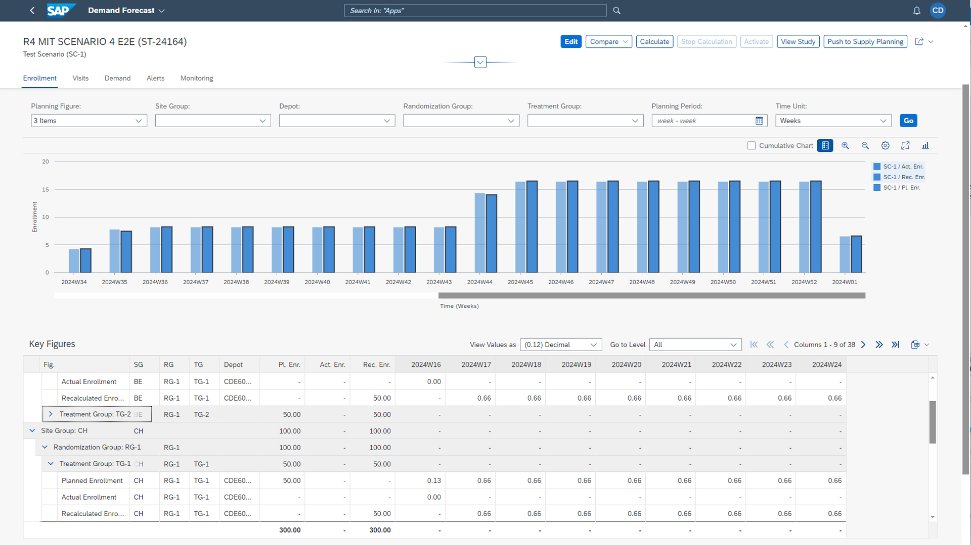
Early prototype of the Study Setup & Parameters screen showing how trial managers can configure studies, review key figures, and monitor progress.
Feature 2: Planning & Forecasting
Feature Explanation
Enabled demand planning at both drug substance and product levels, supported by deterministic calculations. Users could also simulate multiple planning scenarios based on projected or actual subject enrolment figures.
The "Why" Behind the Feature
Forecasting errors carried huge risks. This feature gave trial managers confidence by combining precise calculations with the flexibility to adapt to real-world changes in enrolment and visits.
"I can simulate different enrollment outcomes and be ready for whatever happens."
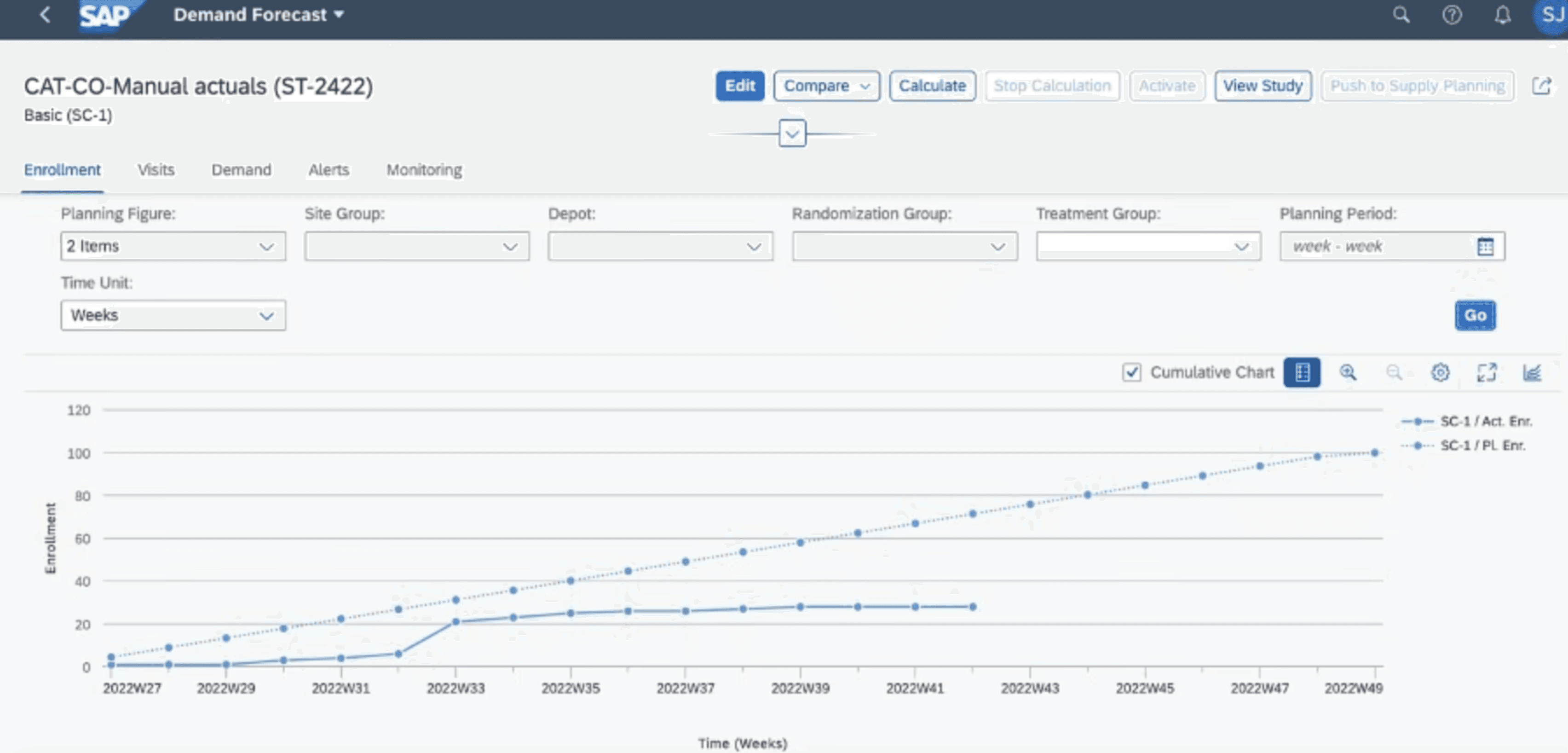
Prototype showing forecasting tools that let trial managers simulate scenarios and plan confidently for changing enrolments.
Feature 3: Manufacturing & Packaging Intelligence
Feature Explanation
Provided tools to manage medication lists for serialised trials, perform batch allocations, calculate expiry dates, and generate data for packaging and labelling workflows.
The "Why" Behind the Feature
Manufacturing and packaging required high precision. This feature supported shelf-life management and ensured that internal and external packaging processes stayed efficient and compliant.
"It takes the guesswork out of batch allocation and expiry calculations."
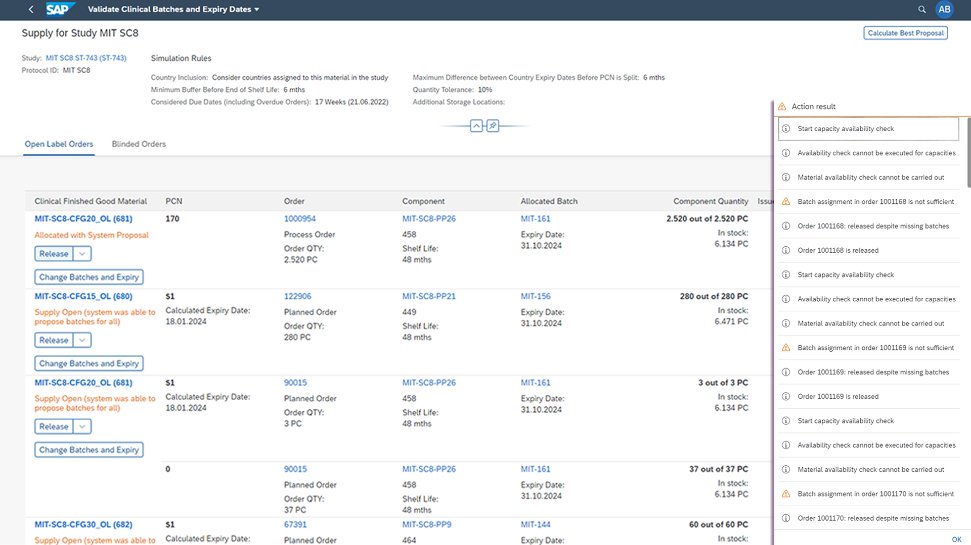
Prototype showing batch allocation and expiry tracking, simplifying shelf-life management and ensuring efficient, compliant packaging.
Feature 4: Stock Visibility & Distribution
Feature Explanation
Introduced deeper stock visibility down to site and kit ID level, with compliance support for import/export and integration with third-party logistics through GS1-standard interfaces.
The "Why" Behind the Feature
Previously, visibility often stopped at the depot level, creating blind spots. This feature improved end-to-end oversight and ensured compliant, efficient distribution across global sites.
"Now I can see exactly where kits are, right down to the site and ID."
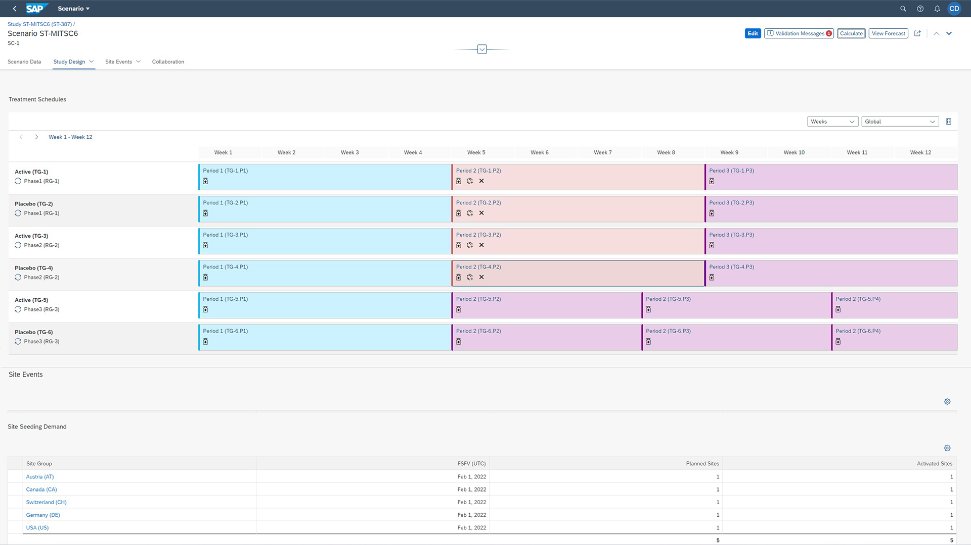
Prototype showing site-level stock visibility and kit tracking for improved oversight and global distribution.
Usability Testing Approach
To ensure our prototypes were usable and effective, we applied a mix of qualitative and quantitative methods:
Qualitative
10 trial managers and supply planners across six countries participated in remote moderated sessions, providing feedback on usability, clarity, and workflow fit.
Quantitative
A follow-up survey with 30 respondents measured ease of use, confidence in decision-making, and likelihood of adoption.
The Results Were Clear: Embedded AI, Not Separate Tools
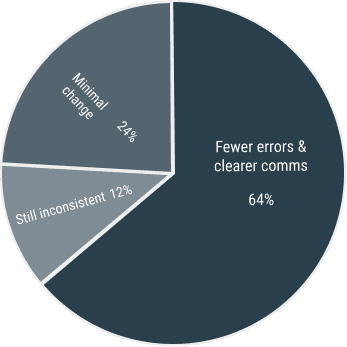
Quantitative Results
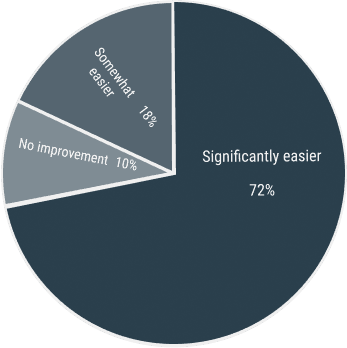
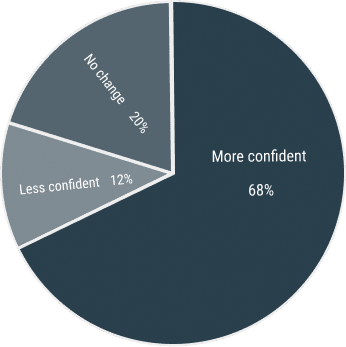
64% of respondents agreed integration reduced errors and improved communication across teams.
Qualitative Validation
"Having everything in one place saves me time and reduces mistakes."
"I feel more confident making changes when I can see the full picture."
"Working in one system makes collaboration across departments much smoother."
The final presentation gained strong support from SAP and pharmaceutical stakeholders. They recognised the platform as a strategic move toward modernising trial supply chains, and approved the recommendation for pilot rollout discussions with partner companies to validate its impact in real-world studies.
IMPACT
The Power of Reframing
Over the course of the project, we challenged a core assumption: rather than introducing yet another tool, would trial managers and planners benefit more from a single integrated platform?
This reframing shifted the focus toward unification and led to:


Operational benefits for trial managers and planners, with faster adjustments to enrolment shifts and fewer risks from errors.

Industry credibility, with SAP and pharma partners recognising the platform as a benchmark for clinical trial supply chains.
Long-Term Value for SAP ICSM
The project created impact that extended well beyond the prototype:
Delivered a validated design prototype that informed pilot planning with pharmaceutical partners
Embedded human-centred design practices (personas, workflow mapping, journey mapping) into a traditionally compliance-driven domain
Sparked ongoing discussions across SAP and partner organisations about how digital platforms can improve transparency, compliance, and collaboration in clinical supply management
What This Meant for Trial Supply Management
For trial managers, the platform provided a reliable way to plan and compare scenarios with less dependency on spreadsheets and manual updates. For supply planners, it offered real-time visibility and flexibility to adjust forecasts without losing accuracy or compliance. Together, it showed how human-centred design can simplify one of the most complex areas of enterprise software, building confidence in decisions where the stakes are extremely high.
REFLECTION
Designing for Complexity, Delivering Clarity
This project challenged me to simplify one of the most complex domains in enterprise software, align global stakeholders, and create a solution that was both practical for day-to-day operations and scalable for the future of clinical trial supply management.
🧪 Understanding High-Stakes Needs
Clinical supply planning is not only about logistics but also about the pressure and accountability managers face when mistakes carry enormous financial and clinical consequences. Research revealed that trial managers needed clarity and confidence, while supply planners needed tools that reduced manual burden without disrupting compliance.
What I Did
Facilitated remote discovery workshops to capture operational pressures across six countries
Translated insights into features that balanced simplicity with compliance
Advocated for clarity and transparency as guiding design principles
⏱️ Designing Within Boundaries
We worked within tight regulatory, technical, and timeline constraints, which meant focusing on features that could deliver value immediately. By narrowing scope and prioritising scenario comparison and manual forecasting, we proved that incremental, well-designed features could build trust and momentum for long-term transformation.
What I Did
Prioritised scenario comparison and manual forecasting as MVP features
Created lightweight flows before scaling into a comprehensive prototype
Balanced ambition with what was realistic for early pilots
🌐 Aligning Diverse Priorities
Working with SAP, Tenthpin, and pharmaceutical stakeholders meant aligning groups with very different goals: regulators wanted compliance, planners wanted agility, and sponsors wanted efficiency at scale. Alignment required evidence-backed design and a focus on the shared mission of reducing risk in high-stakes clinical trials.
What I Did
Brought diverse voices together in remote co-creation workshops
Anchored recommendations in user research and testing, not assumptions
Delivered prototypes that resonated with both end users and enterprise stakeholders
💡 My Key Learnings
Integration Builds Confidence
Fragmented tools eroded trust and slowed decisions. A unified platform gave managers confidence to act quickly with reliable data.
Design Within Constraints
Strict regulations and global operations shaped every choice. We proved usability and compliance can work together.
Humanising Enterprise Software
Behind complex systems are people making high-stakes decisions. Human-centred design simplified workflows and reduced risk.
This project reinforced that impactful design in life sciences is not just about features. It is about creating clarity and trust in critical workflows. By focusing on integration, transparency, and user needs, we helped shape a vision for how ICSM can modernise trial supply management and support better outcomes across global studies.